
AI vs Human Creativity: What Is the Future of Marketing?
Introduction
Marketing has always been about ideas, emotions, stories, and connections. Today, Artificial Intelligence (AI) is changing the way marketers create content, analyse data, plan campaigns, and communicate with customers.
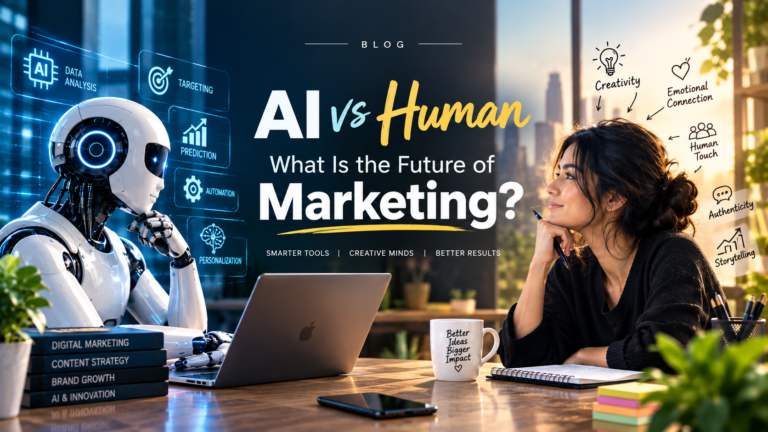
AI can generate content in seconds, suggest ideas, analyse information, and automate repetitive tasks. But human creativity brings something different—emotion, imagination, experience, empathy, and a genuine understanding of people.
So, what will the future of marketing look like? Will AI replace human creativity, or will both work together?
The future is likely to be about combining the speed of AI with the creativity of humans.
🤖 1. What Can AI Do for Marketing?
AI has become a useful tool for digital marketers. It can help complete repetitive and time-consuming tasks faster.
AI can help with:
- Generating content ideas
- Writing first drafts
- Analysing customer data
- Finding trends and patterns
- Creating different versions of advertisements
- Automating repetitive tasks
- Personalising communication
- Supporting customer service
For example, a marketer can ask AI for ten social media ideas and then select, edit, and improve the ones that fit the brand.
AI can make the process faster, but humans still decide what is useful.
🎨 2. What Makes Human Creativity Special?
Human creativity comes from experiences, emotions, imagination, observations, and understanding people.
A human marketer can understand why a particular story feels emotional or why a certain message connects with an audience.
Human creativity is especially important for:
- Storytelling
- Emotional connection
- Original ideas
- Brand personality
- Understanding customer feelings
- Cultural context
- Creative strategy
- Building relationships
A customer does not connect with a brand simply because its content is perfect. They connect when the message feels real, relatable, and meaningful.
🧠 3. AI Can Generate, But Humans Give Meaning
AI can produce hundreds of ideas, but not every idea will be right for a particular brand.
Imagine a coffee brand wants to create a campaign about friendship. AI can suggest captions, slogans, and campaign ideas.
But a human marketer needs to decide:
- Does the idea match the brand?
- Will customers relate to it?
- Does it create the right emotion?
- Is it original?
- Will people remember it?
This is where human judgement becomes important.
AI can create the pieces, but humans give those pieces meaning.
⚡ 4. AI Makes Marketing More Efficient
One of AI’s biggest advantages is speed. Marketers often spend a lot of time researching, creating drafts, preparing reports, and developing campaign variations.
AI can help reduce the time spent on these tasks.
This gives marketers more time to focus on:
- Strategy
- Creativity
- Campaign planning
- Customer understanding
- Brand building
- Decision-making
Instead of replacing creativity, AI can give marketers more time to focus on creative thinking.
❤️ 5. Human Emotion Still Matters
At the centre of every marketing campaign are people.
Customers have feelings, memories, experiences, preferences, and expectations. Understanding these emotions is an important part of effective marketing.
A human marketer can ask:
“How will this message make the customer feel?”
A simple advertisement may be technically perfect, but a meaningful story can make people remember a brand for a long time.
This is why emotional storytelling remains important even when technology becomes more advanced.
People may notice a message, but they remember how a brand made them feel.
📊 6. Data and Creativity Can Work Together
AI is very useful for analysing large amounts of information.
It can help marketers understand:
- Customer behaviour
- Content performance
- Audience interests
- Campaign results
- Search trends
- Customer preferences
Human marketers can use these insights to make creative decisions.
For example:
AI can show which type of content performs well.
The marketer can then understand why people liked it and create more meaningful content around that idea.
This combination brings together data-driven decisions and human creativity.
⚠️ 7. The Danger of Depending Too Much on AI
AI is powerful, but using it for everything can create problems.
If every business uses AI to produce similar captions, images, and ideas, content can start feeling repetitive and less personal.
Some possible problems include:
- Generic content
- Lack of originality
- Weak brand personality
- Incorrect information
- Less emotional connection
- Content that sounds unnatural
That is why AI-generated content should be reviewed, edited, and adapted before it becomes part of a brand’s communication.
Use AI as an assistant, not as the entire creative team.
🚀 8. The Future Is AI + Human Creativity
The future of marketing does not have to be AI versus humans.
Instead, marketers can use both.
A simple workflow could be:
AI helps with research → Human creates the strategy → AI supports content creation → Human adds creativity → Data measures performance → Human improves the campaign
This approach combines the strengths of both.
AI provides speed and efficiency, while humans provide creativity and emotional understanding.
🌱 9. What Skills Will Marketers Need?
As AI becomes more common, digital marketers will need more than knowledge of marketing tools.
Important skills include:
- Creative thinking
- Strategic planning
- Storytelling
- Communication
- Data interpretation
- Customer understanding
- Brand building
- Critical thinking
- AI tool knowledge
Knowing how to use AI is useful, but knowing when to use it and how to use it creatively is even more important.
💡 10. AI Is a Tool, Not the Strategy
AI can support marketing, but it cannot replace the need for a clear brand strategy.
Businesses still need to understand:
- Who are our customers?
- What problem do we solve?
- What makes our brand different?
- What do we want people to remember?
- What story do we want to tell?
Once these questions are clear, AI can help execute the plan more efficiently.
Technology can support the strategy, but the human idea should remain at the heart of the brand.
Conclusion
The future of marketing is not simply about choosing between AI and human creativity. It is about using the strengths of both.
AI can provide speed, data, automation, and efficiency. Humans bring emotion, imagination, strategy, empathy, and originality.
When these strengths come together, marketers can create content and campaigns that are both efficient and meaningful.
The brands that stand out in the future will need technology, but they will also need something technology cannot easily replace—a genuine human connection.